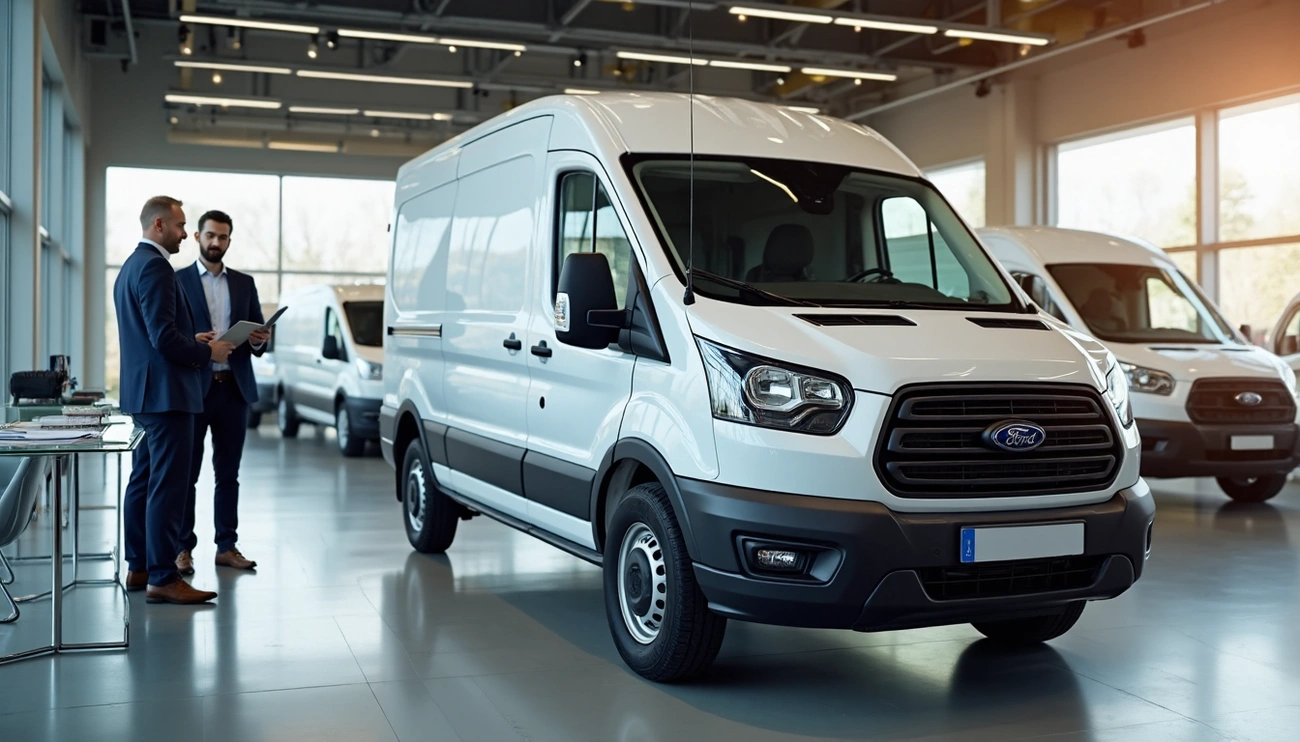
Business Van Leasing: Expert Guide to Saving Money in 2025
Business van leasing delivers clear cost advantages over purchasing outright. Lower upfront payments and predictable monthly costs help preserve your cash flow while giving you access to the commercial vehicles your business needs. Source
Van leasing works as a rental agreement for a set period, usually two to four years. VAT-registered businesses can claim back monthly lease payments as tax-deductible expenses. You’ll need an initial payment – typically one to twelve monthly instalments – but this remains significantly smaller than purchasing costs. See all van leasing deals
This guide covers everything you need to know about business van leasing. We’ll examine how it works, the financial benefits, finding quality lease deals, and potential challenges to consider. Whether you operate a small delivery service or manage a large fleet, we’ll help you decide if van leasing fits your business needs in 2025.
What is business van leasing and how does it work?
Business van leasing provides access to commercial vehicles without ownership commitments. You pay fixed monthly fees for an agreed period, then return the vehicle or explore other options depending on your agreement type. See short term van leasing
How leasing differs from buying
The difference between leasing and buying comes down to ownership. Purchase a van and you pay the full amount upfront or through financing – you own the asset. With leasing, you rent the vehicle for a set period while making regular monthly payments. See business van leasing
Leasing offers several advantages over buying:
- Fixed monthly costs – Leasing provides consistent monthly payments, making budgeting manageable for your business operations.
- Avoiding depreciation – You won’t be left with a depreciating asset. At contract end, you simply return the van and can upgrade to a newer model.
- Lower initial outlay – Leasing requires smaller upfront payments compared to buying, preserving cash flow for other business needs.
- Tax advantages – VAT-registered businesses can claim up to 100% of VAT back on monthly payments, plus claim lease payments as business expenses.
Types of van lease agreements
Four main types of business van lease agreements are available in the UK market:
Business Contract Hire is the most popular form, representing leasing in its purest form. You pay monthly to use the van and return it at contract end. This option offers the lowest initial payments and removes any risk of being stuck with a depreciated asset.
Finance Lease gives you responsibility for the vehicle at contract end. After making monthly payments throughout the term, you’ll need to sell the van on behalf of the finance company, keeping a percentage of the proceeds. This carries some risk if the van depreciates more than expected.
Contract Purchase suits businesses wanting to own their vehicle eventually. Monthly payments tend to be higher than other options, with a final payment due at the end if you choose to take ownership.
Lease Purchase allows you to spread costs with the intention of owning the van at the end through a final balloon payment. Unlike Contract Hire, there are no mileage restrictions, and the asset can appear on your balance sheet.
Typical lease terms and conditions
Most business van lease contracts run for 2-5 years, with 24, 36, and 48 months being the most common durations. Shorter terms offer greater flexibility, while longer agreements typically result in lower monthly payments.
Several key conditions apply to most lease agreements:
- Mileage limits – Your estimated annual mileage is used to calculate monthly payments. Exceeding your stated mileage can result in excess charges, with most leasing companies limiting allowances to 50,000 miles annually.
- Insurance requirements – Full comprehensive insurance is mandatory throughout the contract period.
- Maintenance responsibility – The van must be serviced according to manufacturer guidelines, typically once annually. Many lease agreements offer optional maintenance packages for an additional monthly fee.
- Return conditions – When returning the vehicle, it must meet the lessor’s fair wear and tear guidelines. Excessive damage beyond normal wear and tear will incur additional charges.
- Early termination – While possible to end contracts early, this usually involves settlement fees determined by the leasing company.
Registration and road tax are typically included in your rentals, especially with Contract Hire agreements. Most vehicles come with standard manufacturer warranties ranging from 3-5 years.
Top Financial Benefits of Leasing a Van in 2025
Smart financial decisions separate successful businesses from struggling ones. Van leasing provides clear financial advantages for businesses managing transportation needs without draining capital resources.
Lower Upfront Costs
Business van leasing reduces initial financial burden compared to outright purchases. You’ll typically provide an initial payment equivalent to a few months’ rental, preserving working capital for critical business areas like marketing, inventory, or expansion.
New businesses or those with limited capital find this reduced initial outlay particularly valuable. Freed-up cash can fund revenue-generating activities rather than being tied up in a rapidly depreciating asset. This approach enables access to quality vehicles at affordable rates that might otherwise exceed your budget.
Predictable Monthly Payments
Van leasing brings predictability to your finances. Fixed monthly instalments remain unchanged throughout your lease term, making budgeting straightforward and eliminating financial surprises.
These payments typically cost less than loan repayments for purchasing a van outright, improving your monthly cash flow. Many lease agreements include road tax and delivery in the monthly payment, removing hidden fees and providing complete transparency in your financial commitment.
Businesses experiencing seasonal demand fluctuations find this predictability especially advantageous for managing cash flow effectively.
Tax-Deductible Lease Payments
Van leasing offers considerable taxation benefits:
- Lease payments are fully tax-deductible expenses in your profit and loss accounts
- VAT-registered businesses can reclaim up to 100% of the VAT on lease payments when the van is used solely for business purposes
- Even with partial personal use, you could reclaim between 20-50% of the VAT
- Monthly lease costs qualify as allowable business expenses, reducing your taxable profits
Tax advantages vary based on your lease type. Contract Hire allows all rental payments to qualify as tax-deductible expenses in profit and loss accounts. Finance Lease arrangements let you offset interest charges against annual profits. Contract Purchase agreements allow VAT-registered companies to avoid VAT on monthly finance payments.
Avoiding Depreciation Losses
Business van leasing eliminates depreciation concerns entirely. When you purchase a van, it begins losing value immediately – often rapidly during the first few years of ownership.
Leasing arrangements make depreciation irrelevant to your business. You pay only for the van’s use during your contract period rather than absorbing the full depreciation cost. At your lease term’s end, you simply return the vehicle to the leasing company and can upgrade to a newer model if desired.
This arrangement removes concerns about resale value, eliminating the risk of being stuck with a depreciated asset worth significantly less than expected. Your business avoids both the financial impact of depreciation and the hassle of selling a used vehicle.
Hidden ways van leasing saves your business money
Business van leasing provides additional cost savings beyond the obvious financial advantages. These benefits often remain unnoticed in initial calculations but can substantially reduce your operational expenses over time.
Reduced maintenance costs
Van maintenance becomes increasingly expensive as vehicles age. Business van leasing eliminates this concern almost entirely. Most lease agreements include optional maintenance packages covering routine servicing, MOTs, and tyre replacements. Unpredictable repair costs become fixed monthly expenses, making budgeting much simpler.
Lease agreements typically provide warranties covering maintenance, repairs, and breakdowns. Since leased vans are usually brand new, they require less maintenance and experience fewer mechanical problems. This means:
- Reduced vehicle downtime affecting operations
- No unexpected repair bills damaging cash flow
- MOT coverage (first required after 3 years for new vans)
- Breakdown assistance throughout the contract period
Some providers offer “Fuel & Go” packages bundling insurance, servicing, maintenance, and breakdown cover into one monthly payment. This eliminates maintenance-related concerns entirely.
Access to newer, more efficient vans
Regular fleet upgrades represent another overlooked benefit. Business van leasing provides access to the latest models every few years without selling older vehicles. Newer vans offer substantial operational advantages.
Modern vans deliver superior fuel efficiency, directly cutting running costs. They feature enhanced safety systems and connectivity technology that improves driver productivity. These vehicles help future-proof your business against changing regulations.
Strict emissions standards make leasing particularly valuable. Your fleet remains compliant with Ultra Low Emission Zone (ULEZ) requirements and Euro 6 standards. This proves especially important for businesses operating in cities like London or areas with emissions restrictions.
No resale hassle or value loss
Disposing of used commercial vehicles takes time and potentially costs money. Business van leasing eliminates this process completely. You simply return the vehicle to the lessor at contract end.
This arrangement removes all vehicle depreciation concerns. While ownership means your business absorbs the full impact of value loss, leasing transfers this risk to the leasing company. You pay only for the van’s value used during your contract period.
You avoid the complexities of selling used vehicles and negotiating second-hand market prices. No advertising costs, time spent on viewings, or price negotiations – simply hand back the keys and lease a newer model if desired.
Risks and limitations to watch out for
Business van leasing provides excellent value for many companies, but you should understand the potential drawbacks before signing any agreement.
Mileage limits and excess charges
Business van leasing contracts include strict mileage limitations, typically ranging from 10,000 to 30,000 miles annually. Exceeding these limits triggers additional charges, usually calculated on a pence-per-mile basis. These excess charges often range around 10p per mile but can reach up to 30p depending on the vehicle and finance provider. Your mileage allowance is pooled across the entire contract period, but underestimating your requirements can lead to substantial unexpected costs that impact your bottom line.
Wear and tear penalties
Your van undergoes a detailed inspection at contract end against industry standards established by the British Vehicle Rental and Leasing Association (BVRLA). Acceptable wear includes light scratches up to 25mm where primer isn’t showing and small dents up to 10mm (maximum two per panel). Unacceptable damage such as substantial wheel damage, body dents, extensive paintwork scratches exceeding 25mm, and interior tears will incur penalties. These charges are assessed on a repair rather than replacement basis wherever possible.
No ownership or asset value
You never own the van throughout your lease. You must return the vehicle regardless of how much you’ve invested in payments. This means you cannot sell it if your business needs change, nor does your business gain any asset value from the arrangement. Despite making all payments, you have nothing tangible to show for your investment once the lease ends.
Customisation restrictions
Lease agreements typically limit modifications to your business van. Temporary, removable changes like vinyl wraps and decals are commonly permitted, but permanent alterations including drilling holes, changing paintwork, or modifying the vehicle structure are generally prohibited. Any approved modifications must be reversed before returning the van, or you risk facing additional charges. For businesses requiring specialised equipment or branding, these restrictions might prove particularly challenging.
How to find the best van lease deals in 2025
Finding quality van lease deals requires a strategic approach. With numerous options available in 2025, knowing how to navigate the market effectively can save your business thousands of pounds over a lease term.
Compare van lease deals online
Start your search with thorough research using comparison websites and broker services. These platforms let you evaluate offerings from multiple providers simultaneously. You can customise your preferences – initial rental amount, contract length, and mileage allowance – to find deals matching your exact requirements.
Comparison sites refresh their special offers regularly, so bookmark these pages to stay informed about limited-time promotions. Time your search strategically toward month-end when salespeople work to meet targets.
Understand LocoScore and deal ratings
LocoScore provides a powerful value metric that converts complex lease factors into a simple score out of 100. This scoring system adjusts for both term length and mileage, allowing fair comparisons between different deals. Understanding these scores helps identify genuine bargains:
- 90-100: Exceptional value deals that sell quickly
- 80-89: Still excellent value, typically half the cost of equivalent PCP deals
- 60-79: Good deals worth considering, especially if the price has recently dropped
- Below 60: May still be cheaper than PCP but not the best available
Negotiate mileage and upfront terms
Enter negotiations well-prepared to strengthen your position considerably. Almost everything in a lease agreement can be discussed – notably the initial payment, mileage allowance, and sometimes even the gross capitalised cost.
Estimate your annual mileage realistically, as exceeding limits can result in expensive penalties. Request higher mileage at a discounted rate – this often proves more economical than paying excess charges later.
Look for no-deposit lease options
No-deposit van leasing eliminates the need for large upfront payments, making it ideal for businesses with limited immediate capital. These arrangements typically involve slightly higher monthly payments or extended terms, yet they provide greater initial financial flexibility.
For startups or businesses with cash flow constraints, no-deposit leasing delivers access to essential vehicles without draining working capital. Fast lease services offering quick delivery on stock vans might be worth exploring when immediate vehicle access is necessary.
Conclusion
Business van leasing provides a practical solution for companies managing commercial vehicle needs without major capital outlay. This guide has shown how leasing offers financial advantages over purchasing while delivering operational flexibility for businesses of all sizes.
The financial case for leasing remains strong. Lower initial payments preserve working capital, while fixed monthly costs simplify budgeting. Tax advantages allow VAT-registered businesses to reclaim significant portions of lease payments, reducing overall expenses. Most importantly, leasing protects your business from depreciation losses – a major cost when purchasing vehicles outright.
Additional savings strengthen the leasing proposition. Maintenance packages convert unpredictable repair costs into manageable monthly expenses. Access to newer, more efficient vehicles reduces fuel consumption and ensures compliance with evolving emissions regulations. Eliminating resale tasks saves time and resources that can focus on core business activities.
However, leasing includes limitations requiring careful consideration. Mileage restrictions may challenge businesses covering extensive distances, while wear and tear penalties can accumulate without proper vehicle care. The lack of ownership means payments never build equity in an asset. Customisation restrictions could pose difficulties for businesses requiring specialised modifications.
Finding the right leasing arrangement requires thorough research and strategic negotiation. Comparison websites provide excellent starting points, while understanding metrics like LocoScore helps identify valuable deals. Negotiating favourable mileage allowances and upfront terms often yields substantial savings over the contract period.
Business van leasing works best when matched to your specific operational needs and financial situation. Companies prioritising cash flow preservation, predictable expenses, and regular fleet updates will find leasing particularly beneficial. Businesses requiring extensive customisation or covering unusually high mileages might benefit from exploring alternative arrangements.
Van leasing continues evolving in 2025 with increasingly flexible terms and competitive rates. Taking time to understand your exact requirements before committing ensures you’ll secure arrangements that truly support your business objectives.
Key Takeaways
Business van leasing in 2025 offers compelling financial advantages that can significantly reduce operational costs whilst preserving cash flow for growing businesses.
• Van leasing requires minimal upfront investment compared to purchasing, preserving working capital for core business activities and growth opportunities.
• Fixed monthly payments eliminate depreciation risk and provide predictable budgeting, with lease costs being fully tax-deductible for businesses.
• Access to newer, fuel-efficient vehicles reduces maintenance costs and ensures compliance with evolving emissions regulations like ULEZ requirements.
• Mileage restrictions and wear-and-tear penalties can create unexpected costs, making accurate usage estimation crucial before signing agreements.
• Compare deals using LocoScore ratings and negotiate mileage allowances upfront to secure the most cost-effective leasing arrangements for your business needs.
The key to successful van leasing lies in matching the agreement terms to your specific operational requirements whilst taking advantage of the tax benefits and cash flow improvements it provides.